
Startup Snapshot
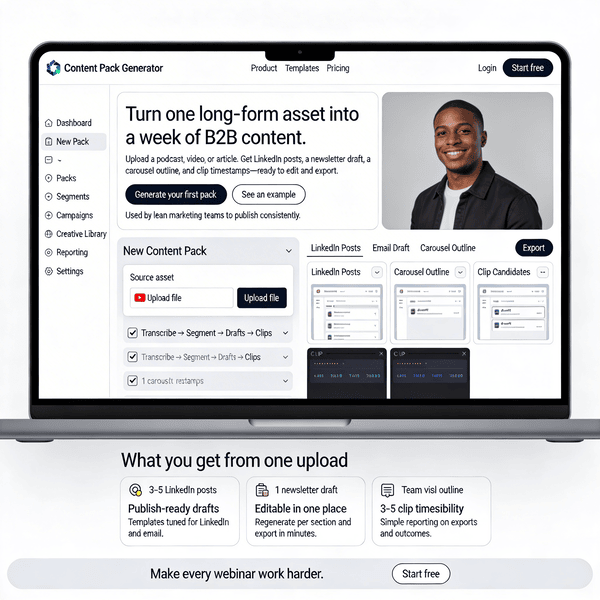
This is a SaaS product that turns a single long-form asset (podcast, YouTube video, webinar, or article) into a publish-ready content pack: LinkedIn post drafts, an email newsletter draft, a carousel outline, and timestamped short-clip candidates.
It’s built for B2B marketing teams that already create long-form content but struggle to distribute it consistently. The core problem is that repurposing is slow, fragmented across tools, and hard to standardize across a team.
The primary value delivered is speed-to-distribution: a marketer can go from “we recorded something” to “we have a month of drafts to ship” with one workflow.
The product stays practical by focusing on editable drafts and export, not complex publishing automation.
Ideal founder profiles
- A B2B SaaS operator who understands content-led growth and has lived the “we need more posts” pain.
- A product-minded marketer who can define templates, workflows, and quality bars (and sell them).
- A solo technical founder who can ship a workflow product quickly and iterate with early users.
- An agency operator who wants to productize internal repurposing SOPs into a subscription tool.
- A founder comfortable running founder-led sales to 20–100 early customers before scaling channels.
Not a good fit for
- Founders who want a consumer viral product or creator entertainment focus (this is workflow software for teams).
- Teams who want to start with fully automated video editing/rendering and platform posting on day one (too heavy for a fast MVP).
- Builders unwilling to do hands-on onboarding and output QA early (quality perception is the whole game).
B2B companies are producing more long-form content (webinars, podcasts, founder interviews), but distribution is the bottleneck: every asset can fuel dozens of posts, yet most teams ship only 1–2 derivatives because repurposing takes too long.
LinkedIn and email remain core channels for B2B distribution, which makes “platform-specific drafts” a high-frequency need rather than a one-off project.
The timing is strong because teams are under pressure to do more with lean headcount and reduce reliance on contractors.
Scale potential is meaningful: this can be a $1M+ ARR business with roughly 300–1,000 customers depending on pricing (e.g., $99–$299/month ARPA), and there’s a natural upgrade path into teams and agencies.
Primary model: subscription tiers based on usage (number of source assets processed per month) plus seats/workspaces.
Typical price ranges:
- Starter: ~$79–$129/month (1–2 users, limited monthly packs).
- Team: ~$249–$499/month (3–10 users, more packs, shared templates).
- Agency/High-volume: ~$799–$1,999/month (multiple client workspaces, high pack limits, priority support).
Higher LTV comes from: multi-user adoption (more seats), higher processing volume (more packs), and workflow lock-in as teams store templates, creatives, segments, and campaigns inside the system.
Business Plan (outcome: clear, buildable strategy)
- A buyer-ready plan covering positioning, ICP, differentiation, pricing options, GTM for first 90 days, operating model, risks, and metrics tied to $1M+ ARR execution.
12-Week Execution Roadmap (outcome: no-guesswork delivery plan)
- A week-by-week build and launch schedule with tasks across product/engineering, design, growth, and ops—plus acceptance criteria and scope controls to prevent MVP bloat.
MVP Build Blueprint (outcome: build scaffold you can execute)
- A no-code-friendly specification with data models, screens, logic/automations, admin controls, and instrumentation so a small team can produce a working prototype fast.
- Source asset intake: link/upload/paste.
- Processing pipeline: transcription (or transcript input), segmentation, draft generation.
- Content pack outputs: 3–5 LinkedIn drafts, 1 email draft, 1 carousel outline, 3–5 timestamped clip candidates with suggested captions.
- Editor workflow: revise drafts, regenerate individual drafts, export text and timestamps.
- Feedback capture on outputs (usable/not usable + reason codes).
- Preferences + consent center with logging (auditable records).
- Rule-based segment builder with time windows (e.g., “exported in last 7 days”).
- Campaign builder with channel placeholders (no external sending required).
- Creative library with basic A/B variant mechanism.
- Reporting dashboard: conversions (proxy), ROAS proxy, frequency, and segment size changes.
What problem the MVP definitively solves
- It makes repurposing predictable and fast for B2B teams by producing a complete set of drafts from one source in a single workflow.
What success looks like at MVP stage
- Users reliably generate packs, export drafts, and come back weekly to process new assets; teams can run basic lifecycle campaigns and see reporting signals.
- Fully rendered short-form video clips (subtitles, templates, auto-editing).
- Social scheduling, email sending, and direct platform integrations.
- CRM attribution, multi-touch attribution, ad spend ingestion.
- Advanced permissions, SSO, enterprise compliance packaging.
- Predictive scoring, automated optimization, or complex personalization logic.
- Multi-language localization and dubbing.
This wins by being workflow-first and output-complete: one input produces a standardized pack a marketer can actually publish, not a generic summary.
The differentiation is focus: B2B distribution formats (LinkedIn + newsletters) and a review/edit/export flow that matches how teams work. It also builds structural stickiness by capturing drafts, templates, segments, campaigns, and performance signals in one system—making it harder to replace with a patchwork of tools.
Execution matters more than novelty because customers judge you on “Can I ship content faster this week?” not on fancy features.
- Build complexity: Medium.
- Time to MVP: 12 weeks (realistic with tight scope).
- Skills required: full-stack product build, pragmatic UX for editing workflows, comfort with content templates, and founder-led sales/onboarding.
- Common failure points to avoid:
- Trying to ship auto video rendering + posting integrations too early.
- Producing drafts that feel generic because templates and voice controls are too thin.
- Skipping instrumentation and reporting, then being unable to prove value or iterate.
- Ignoring consent/preferences management, which hurts trust and future sales.
- Add rendered clip creation and branded templates as a paid add-on.
- Add real delivery integrations (email providers, scheduling tools) while keeping the campaign model intact.
- Agency mode: multi-client workspaces, approvals, and bulk processing.
- Performance feedback loop: recommend winning hooks, formats, and topics based on what converts.
- Enterprise angle: stronger controls (SSO, retention policies, audit exports) for larger teams.
Buy this if you want to build a practical B2B workflow product that helps teams ship more content from the assets they already create—and you’re willing to win on quality, speed, and adoption rather than flashy features.
The best fit is a founder who ships quickly, iterates with real users, and is comfortable doing hands-on onboarding and sales early.
This is worth building because it targets a recurring operational bottleneck with clear willingness to pay and a straightforward path to $1M+ ARR through team and volume expansion.