🌱 Spring Sale — 50% Off All Startup Kits Through March 31st

Claim Your Discount →

AI Social Ad Optimization and Testing SaaS
Startup Snapshot

This business is a service-enabled software product that helps performance marketers run a repeatable weekly optimization cycle for paid social, starting with Meta-style campaign data.

It’s built for SMB marketers and small agencies who need clearer decisions on what to pause, what to scale, and what creative test to run next.

The core problem is that teams waste budget and time because optimization is inconsistent, poorly documented, and driven by reactive guesswork.

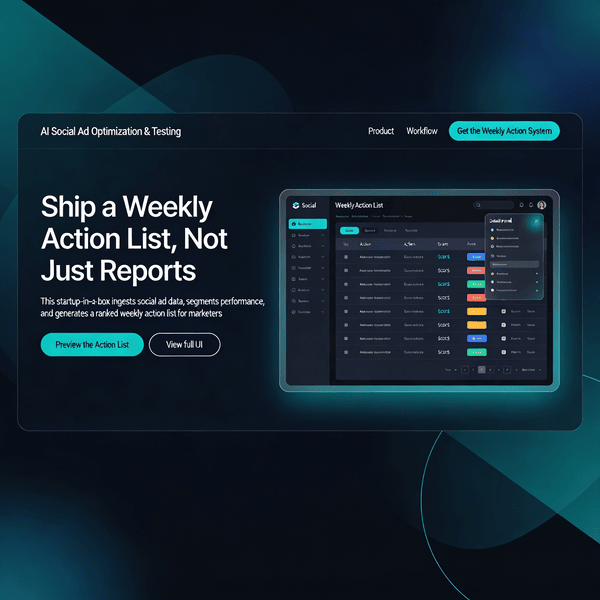
The product turns raw performance inputs into simple segments, a campaign plan (with channel placeholders), a creative A/B test workflow, and a ranked weekly “next actions” list with approvals and an implementation log.

The primary value delivered is higher test velocity with fewer bad changes, plus a client-ready weekly summary that makes the work easy to communicate.

Who This Is For (and Who It’s Not)

Ideal founder profiles

  • A former media buyer or performance marketer who has managed real budgets and wants to productize their weekly workflow.
  • A small agency owner who wants to standardize delivery, reduce account-by-account variance, and increase margins.
  • A technical solo founder comfortable building data pipelines, dashboards, and rule-based logic (not reliant on advanced ML).
  • An operator who likes systems, checklists, and measurable weekly routines more than “big brand” storytelling.
  • A founder who can sell into agencies via outbound and partnerships and iterate quickly with pilot feedback.

Not a good fit for

  • Someone who wants a fully automated “hands-off” optimization engine on day one (this starts with approvals and manual implementation).
  • A founder who dislikes customer-facing onboarding, pilots, and weekly feedback loops.
  • Anyone looking for a broad marketing suite (email, CRM, attribution, multi-channel) as the initial wedge.
The Opportunity

Paid social spend is still one of the most common growth levers for SMBs and agencies, but the operational layer is weak: most teams rely on dashboards and human judgment without a consistent testing and change-control system.

That gap creates demand for workflow software that tells teams what to do next, not just what happened. The market is broad: there are thousands of small agencies and a massive base of SMB advertisers; a focused product can reach meaningful scale without needing enterprise adoption.

A realistic path to $1M+ annual revenue is driven by agency accounts (multi-client expansion) and recurring weekly usage that supports strong retention.

How It Makes Money

Primary revenue models

  • Subscription tiers based on number of ad accounts and usage level (typical ranges: $199–$499/month for SMB, $499–$1,999/month for agencies).
  • Optional implementation add-on (“done-with-you”): monthly fee tied to change volume and responsiveness (typical ranges: $500–$3,000/month).

What drives higher LTV over time

  • Becoming the agency’s weekly operating system (segments → tests → actions → report), which makes churn costly.
  • Adding multi-account workflows, templates/playbooks, and better reporting that agencies can standardize across clients.
  • Upselling implementation, premium workflows, and later, additional channels.
What You’ll Get

Business Plan

  • A buyer-ready, execution-grade plan that defines the wedge, the product logic, competitive reality, pricing models, GTM for the first 90 days, and the operational model (including the service layer).

12-Week Execution Roadmap

  • A week-by-week build and launch plan with parallel tracks (engineering, design, growth, ops), clear acceptance criteria, and strict scope controls to ship a usable MVP in 12 weeks.

MVP Build Blueprint

  • A no-code-friendly build spec covering data models, screens, user flows, rules/automations, admin configuration, and instrumentation so a solo founder or small team can scaffold the product without guesswork.
MVP Scope (What’s Included)
  • Data ingestion via structured file upload using a template (Meta-like performance inputs).
  • Identity/profile concept with minimal stitching rules and strict account-level separation.
  • Consent & preferences center with logging and export.
  • Rule-based segment builder with time windows and minimum thresholds.
  • Campaign builder with channel placeholders and segment allocation weights (publish creates a versioned delivery plan spec).
  • Creative library with basic A/B variant setup and an experiment object tied to a campaign version.
  • Reporting dashboard showing conversions, ROAS proxy, frequency, and segment size changes, plus weekly summaries and share links.
  • Weekly ranked “next actions” list with approve/ignore/snooze and a manual “applied” log (service-enabled workflow).

What problem the MVP definitively solves

  • It gives teams a repeatable weekly system for deciding and documenting optimization actions and tests, without relying on ad-hoc spreadsheets and inconsistent human process.

What success looks like at MVP stage

  • New users can onboard, upload data, create segments and a test, generate a weekly report, and work through an action list in under an hour.
  • Agencies use it weekly across multiple client accounts and share the weekly summary with clients.
What’s Intentionally Not Included (Yet)
  • Live ad platform integrations and real account connections (MVP validates value with structured uploads).
  • Automated execution of changes inside ad platforms (kept manual/approval-based to avoid risk and complexity).
  • Multi-channel reporting and budget optimization (single-channel workflow first).
  • Advanced attribution, incrementality testing, or MMM.
  • Complex segmentation logic (nested OR groups, clustering) and sophisticated experimentation statistics.
  • Full self-serve billing automation if it slows launch (can start with simple upgrade requests and manual invoicing).
Why This Can Win

This wins through workflow design, not novelty: it turns optimization into an accountable weekly cadence with segments, tests, approvals, and a change log tied to outcomes.

The differentiation is “what to do next” plus operational discipline (experiment tracking, versioned campaign plans, and client-ready reporting), which most dashboards and generic automation rules don’t deliver in a unified loop.

Agencies create structural leverage: once embedded, the product expands account-by-account and becomes part of service delivery.

Execution matters more than cleverness here because trust, clarity, and repeatability are the product.

Execution Reality Check

Build complexity: Medium

Time to MVP: 12 weeks (realistic with tight scope and file-based ingestion)

Skills required

  • Full-stack implementation of multi-tenant SaaS fundamentals (auth, permissions, data model, background jobs).
  • Product thinking for rule-based segmentation and recommendations (clear thresholds, data sufficiency guardrails).
  • Basic design for dashboards, tables, and an onboarding flow.
  • GTM capability for agency outreach and pilot management.

Common failure points to avoid

  • Trying to integrate ad APIs too early instead of validating the weekly workflow first.
  • Shipping “recommendations” without explanations, thresholds, and data sufficiency warnings (kills trust).
  • Skipping consent/preferences logging and tenant isolation (creates launch blockers later).
  • Building too many features instead of a tight loop that users repeat weekly.
Growth Paths (Post-MVP)
  • Add real ad platform connections and scheduled ingestion once retention is proven.
  • Introduce safe, approval-based “apply changes” automation for low-risk actions (pause, small budget shifts) with rollback concepts.
  • Agency features: multi-client workspace, role permissions, templates/playbooks, white-label reporting.
  • Expand to additional channels (TikTok, Google, LinkedIn) using the same segmentation → action → report loop.
  • Premium layers: implementation services, quarterly optimization audits, and vertical-specific playbooks (DTC, local services, B2B lead gen).
Final Verdict

Buy this if you want to build a practical, sellable product that makes paid social optimization more consistent, measurable, and scalable—especially for agencies.

The best founder mindset is systems-first: ship a tight weekly loop, earn trust, and iterate based on usage rather than chasing broad “platform” scope.

This is worth building because it targets a recurring, high-frequency job with clear ROI and a straightforward path to $1M+ revenue through agency expansion and retention.

Product Information

AI Social Ad Optimizer

AI Social Ad Optimization and Testing SaaS

$297.00

Share Your Valuable Opinions

Cart ( 0)

  • Your cart is empty.