🌱 Spring Sale — 50% Off All Startup Kits Through March 31st

Claim Your Discount →

Personalized Recommendation Engine for E-commerce Marketing
Startup Snapshot

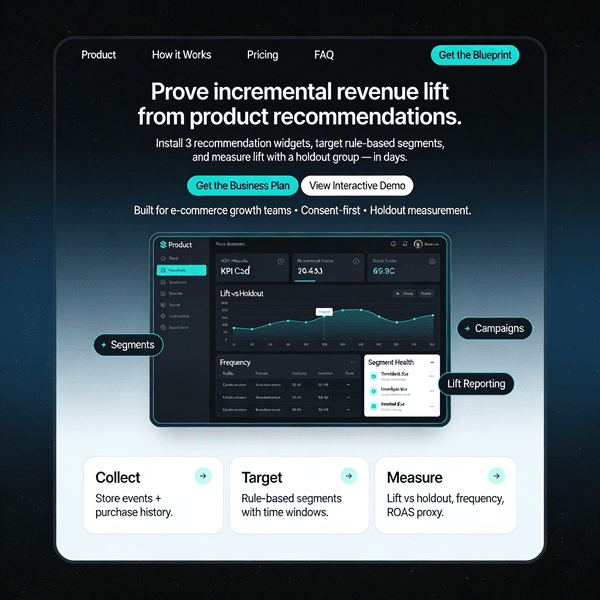
This business is a service-enabled software product that installs personalized product recommendations in the highest-intent parts of an e-commerce experience and proves whether it created incremental revenue.

It’s built for e-commerce marketing managers (and founder-operators) who want conversion and revenue gains they can attribute, not guesses.

The core problem is that most stores show generic “related products,” and teams can’t measure what recommendations actually add versus what would have happened anyway.

The primary value delivered is a repeatable loop: collect behavior and purchase signals → define segments → deliver targeted recommendations → report lift versus a holdout group.

The MVP is intentionally narrow: connect a Shopify store, deploy 3 widgets in 3 placements, and produce a lift dashboard that a marketer can show to leadership.

Who This Is For (and Who It’s Not)

Ideal founder profiles:

  • A full-stack builder who can ship integrations, tracking, and dashboards without overengineering.
  • A CRO/retention operator who’s run A/B tests and knows what “credible measurement” looks like.
  • A small agency owner who wants to turn recurring services into a repeatable product.
  • A technical product manager who can keep scope tight and run pilots with real stores.
  • A founder comfortable selling to marketers and iterating based on weekly feedback.

Not a good fit for:

  • Founders who only want a pure no-code build with zero custom tracking or data work.
  • Anyone expecting a “viral” consumer growth loop; this is B2B with proof-driven selling.
  • People who dislike support and onboarding; early wins come from guided installs and close feedback.
The Opportunity

E-commerce teams are under pressure to do more with the traffic they already pay for, and recommendations are one of the few levers that can raise conversion rate and basket size without increasing ad spend.

The market exists now because storefronts generate rich behavioral signals, but most brands still don’t operationalize them into targeted experiences they can measure cleanly.

This creates demand for tools that ship quickly, integrate cleanly, and report incremental outcomes—not vanity metrics.

Scale potential is broad: a mid-market path to $1M+ ARR can come from a few hundred stores on mid-tier plans, or fewer stores on higher tiers with setup/optimization services layered in.

How It Makes Money

Primary revenue model:

  • Subscription tiers (based on store size/traffic or feature access), typically in the $99–$999/month range for SMB and growth brands, with a higher tier for mid-market.
    Secondary revenue:
  • One-time implementation fee ($500–$5,000) for guided setup, plus optional paid “optimization sprints” or quarterly audits.
    What drives higher LTV:
  • Adding placements (more surfaces where recommendations run), improving reporting credibility, and expanding segmentation and experimentation depth so customers keep the system running year-round.
What You’ll Get
  • Business Plan: A buyer-ready plan that defines the wedge (measured recommendations), the customer, the product strategy (MVP vs scalable version), pricing options, and a concrete go-to-market approach built around pilots and proof.
  • 12-Week Execution Roadmap: A week-by-week build and launch plan with parallel tracks (engineering, design, growth, ops), acceptance criteria, and scope guardrails so a small team can actually ship.
  • MVP Build Blueprint: A build-spec covering data models, screens, logic, automations, admin controls, and instrumentation—clear enough to hand to a developer, a no-code builder, or an agency to produce a functional prototype.
MVP Scope (What’s Included)
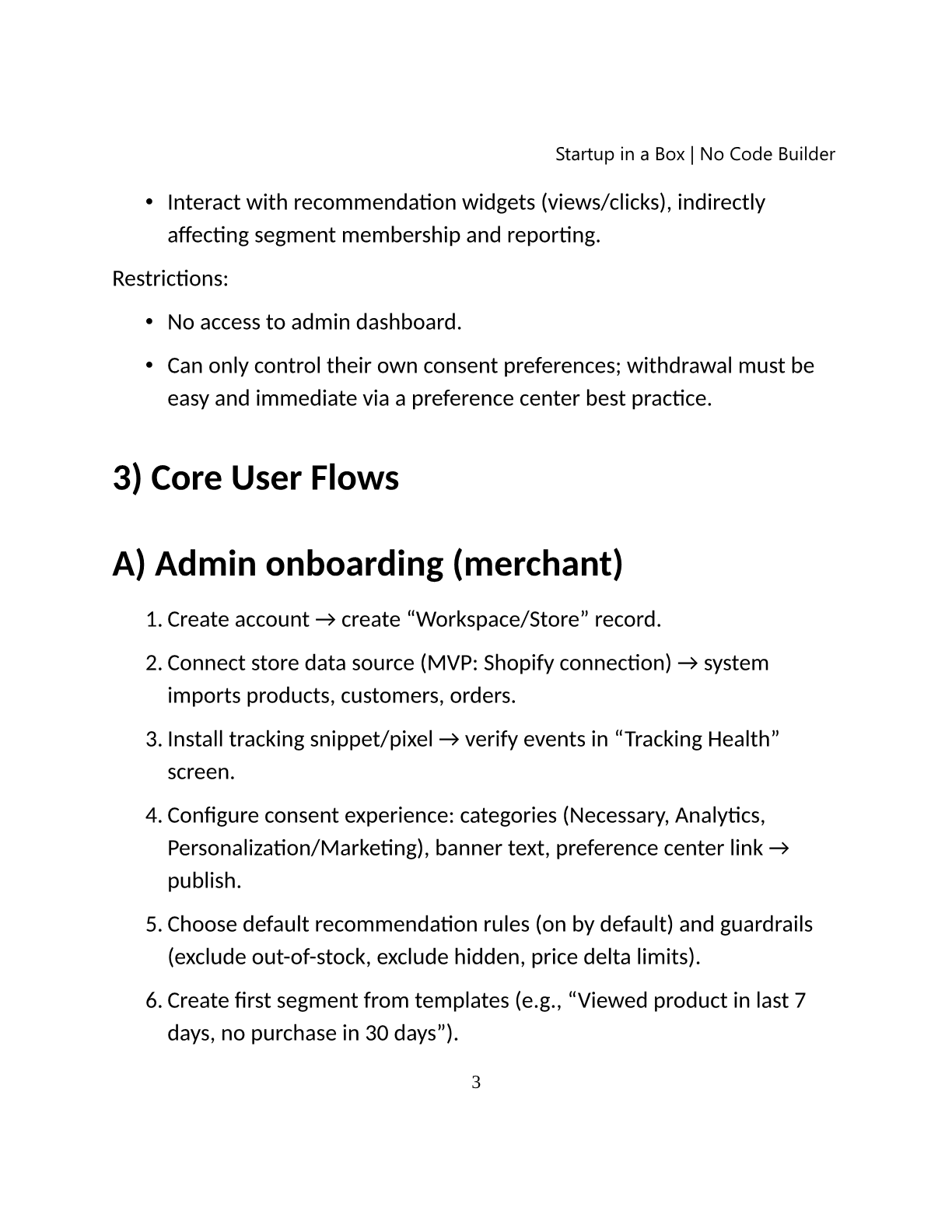
  • Store connection (Shopify first) with catalog + order import.
  • Event tracking for key storefront behaviors (views, add-to-cart, purchase) with a “tracking health” screen.
  • Identity/profile concept with minimal stitching rules (anonymous visitor → known customer when possible).
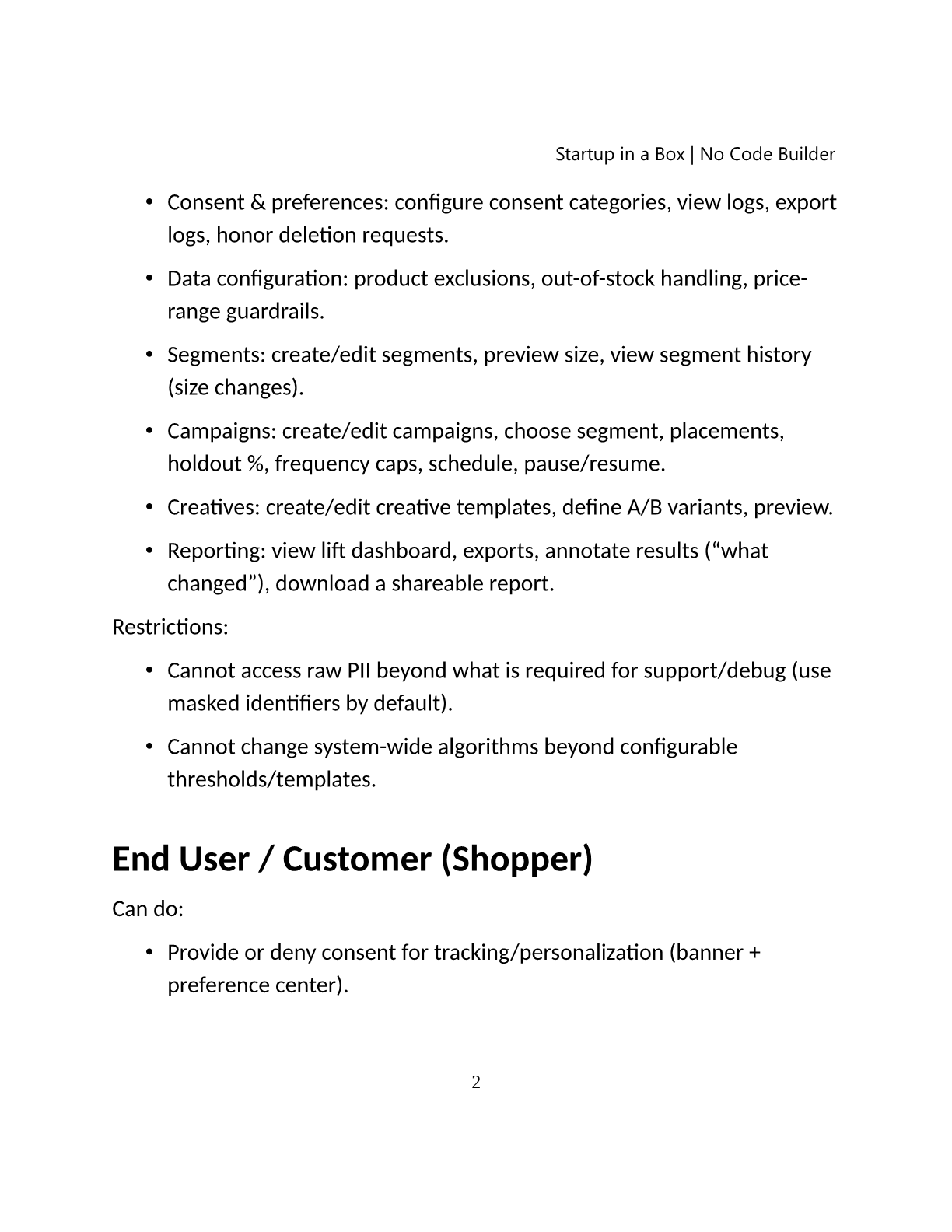
  • Consent and preference center UI plus consent logging and enforcement.
  • Rule-based segment builder with time windows and segment size change tracking.
  • 3 recommendation widgets: frequently bought together, similar items, recently viewed.
  • 3 placements: product page, cart, and a messaging placeholder delivered via export/feed (no sending integration required).
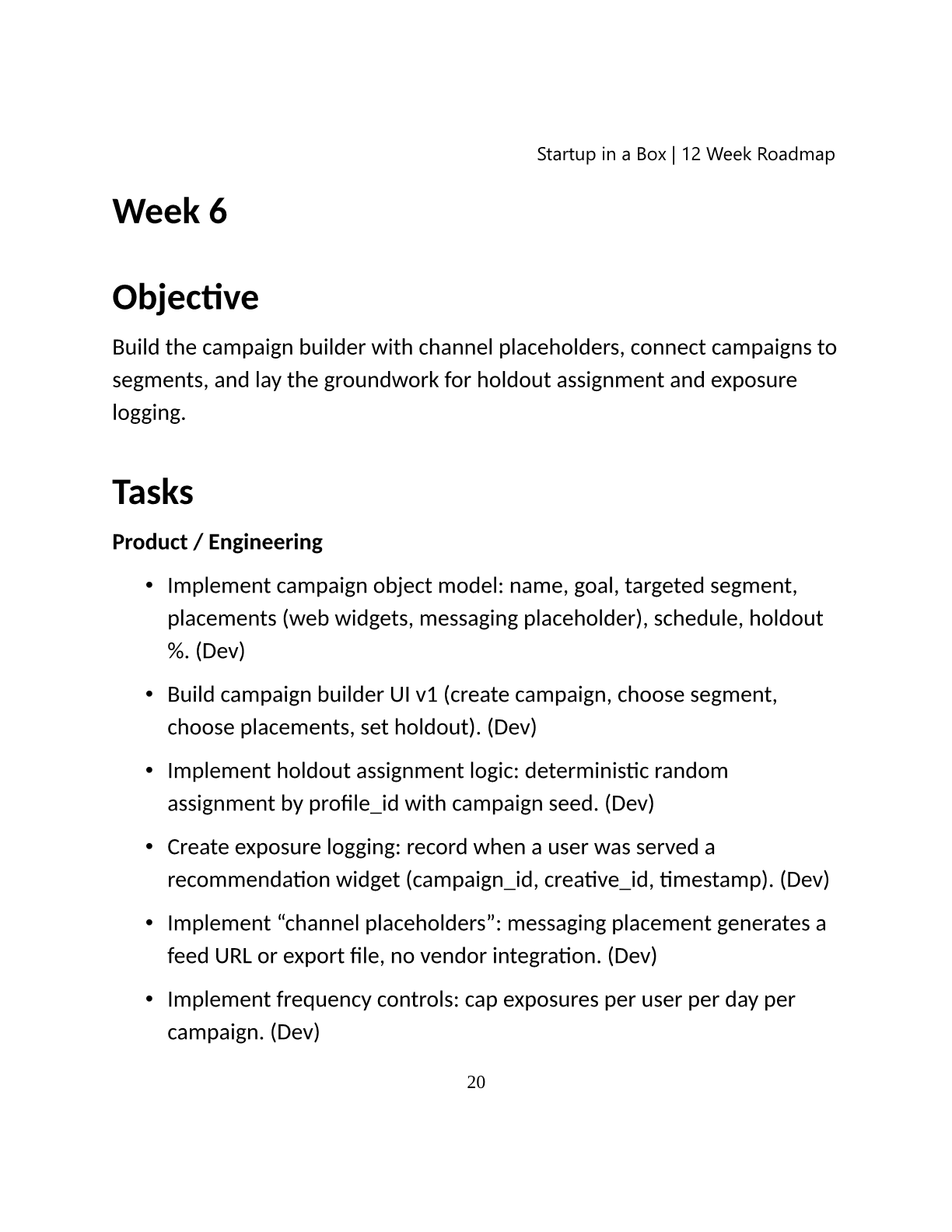
  • Campaign builder with holdout %, frequency caps, and basic creative A/B variants.
  • Reporting dashboard: conversions, ROAS proxy (manual cost input), frequency, segment size changes, and lift vs holdout.

What the MVP definitively solves:

  • “Can we install recommendations quickly and prove incremental revenue lift with credible measurement?”

What success looks like at MVP stage:

  • 5+ stores live, most reaching “campaign active + holdout running” within 1–2 days (guided), and at least a few showing measurable lift over a 2–4 week window.
What’s Intentionally Not Included (Yet)
  • Real email/SMS/ad platform sending integrations (the MVP uses placeholders/exports).
  • Complex ML training, per-store model tuning, or advanced experimentation systems.
  • Multi-platform commerce support beyond Shopify in v1.
  • Enterprise requirements (SSO, SLAs, deep compliance automation).
  • Full visual widget editor or heavy design customization (templates + light controls only).
  • Advanced attribution (multi-touch) or media mix modeling.
Why This Can Win

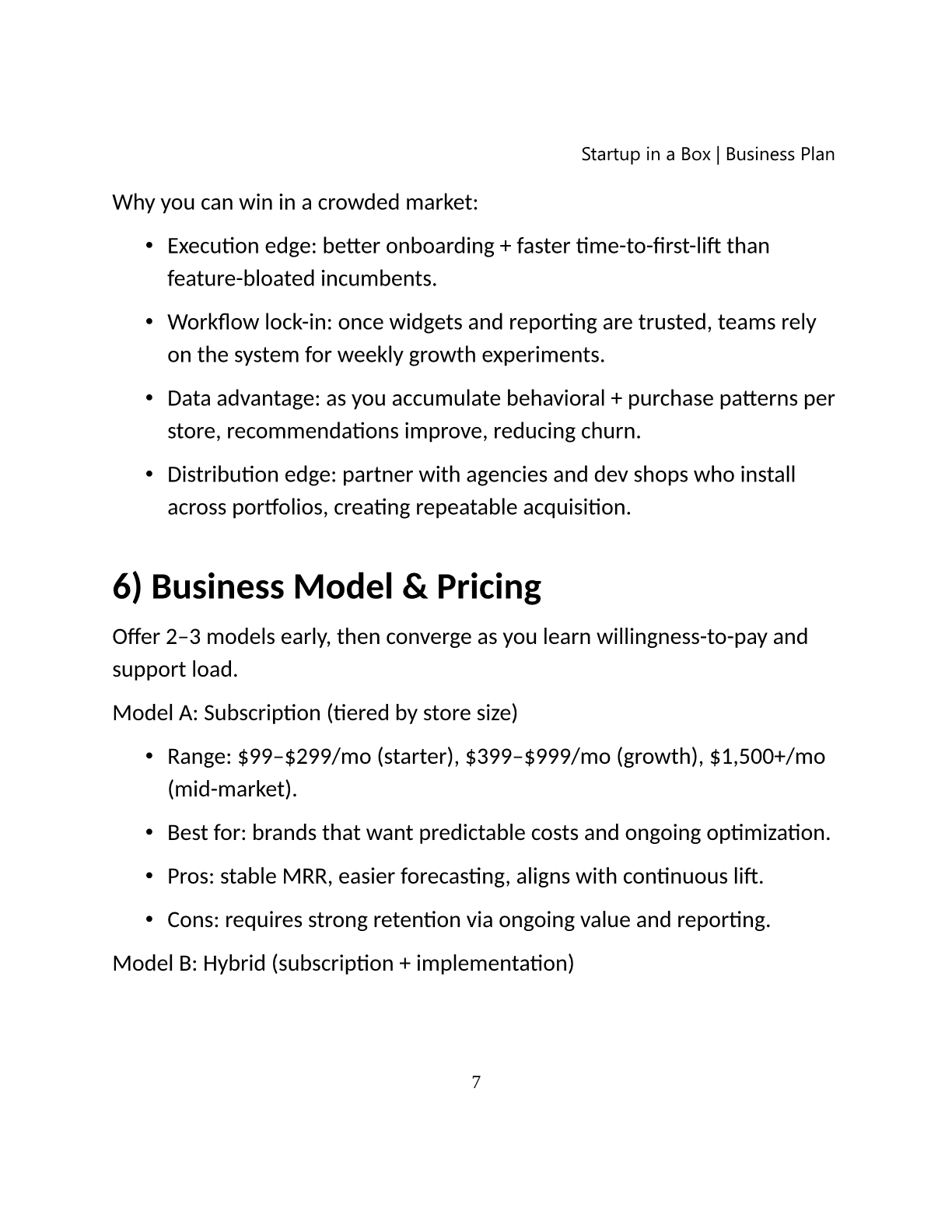
The differentiation is not novelty—it’s speed to value and measurement discipline: a tight set of placements, clear targeting, and lift reporting that reduces internal debate about ROI.

The structural advantage is workflow lock-in: once a store trusts the lift dashboard and runs weekly campaigns, the product becomes part of their growth cadence.

The wedge is narrow enough to ship in 12 weeks but expandable into higher LTV surfaces (more placements, richer segments, deeper experimentation).

Execution matters more than features: the winners in this space are the ones who reduce install friction, build trust in reporting, and consistently produce “here’s what changed revenue” stories.

Execution Reality Check

Build complexity: High (because data reliability, tracking, and measurement credibility are harder than UI).

Time to MVP: 12 weeks with a focused build and guided installs.

Skills required:

  • Full-stack dev with tracking + integration comfort.
  • Product sense for tight scope and onboarding.
  • Basic experimentation literacy (holdouts, comparisons, guardrails).

Common failure points to avoid:

  • Building too many widgets/placements before measurement works.
  • Shipping recommendations without consent controls and audit logs.
  • Overpromising results instead of proving incremental lift with a clear methodology.
  • Getting dragged into custom theme work without productized boundaries.
Growth Paths (Post-MVP)
  • Add more placements (homepage, collections, post-purchase) to increase impact and pricing power.
  • Add more recommendation modes (replenishment, bundles, margin-aware ranking).
  • Expand segmentation into predictive signals (LTV bands, churn risk) once data is reliable.
  • Launch an agency multi-store tier with templated rollouts and reporting.
  • Move upmarket with stronger permissions, auditability, and performance at scale.
Final Verdict

Buy this if you want a focused, measurable e-commerce growth product that can be shipped fast and sold on proof.

This is best for founders who like shipping integrations, running pilots, and winning on “measured outcomes” rather than big feature checklists.

It’s worth building because it targets a persistent, high-value pain: turning existing traffic into more revenue—and proving it credibly.

Product Information

Personalized Recommendation Engine for Ecommerce

Personalized Recommendation Engine for E-commerce Marketing
$247.00

Share Your Valuable Opinions

Cart ( 0)

  • Your cart is empty.